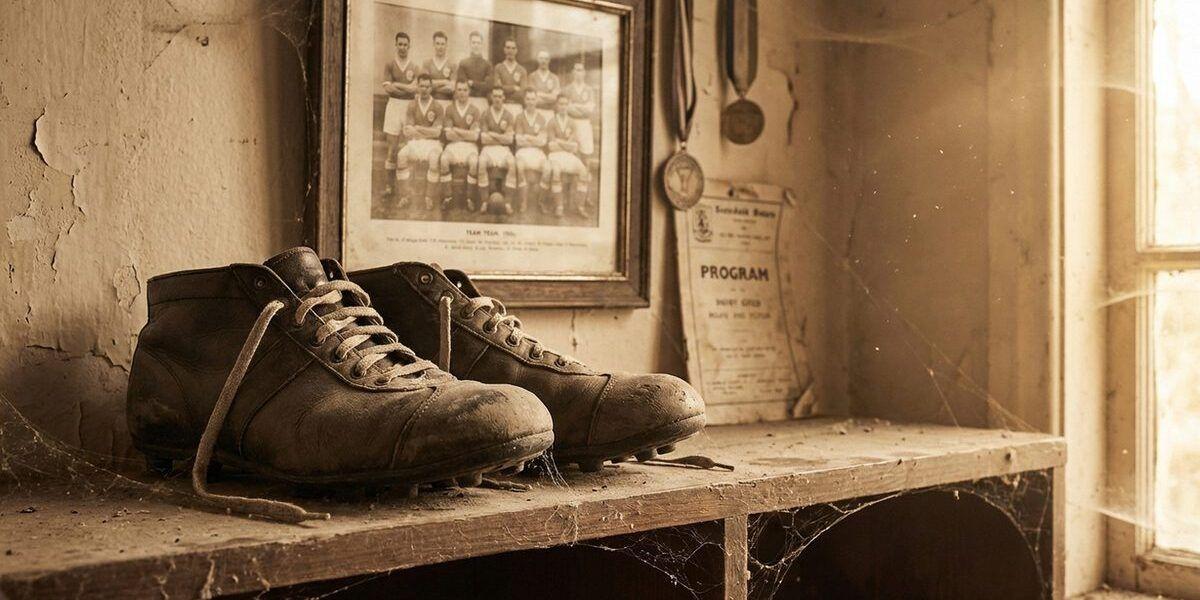
The Ones Who Slipped Through the Cracks of Memory
Football history, like all history, is written by the winners — and by those with the best highlight reels. For every Thierry Henry or Dennis Bergkamp, whose names are etched in golden letters across Arsenal’s story, there are dozens of players whose contributions have been quietly forgotten, whose careers at the club have been reduced to footnotes, pub quiz answers, or blank stares from younger supporters who never saw them play.
This is the introduction to our Players Out of Time series, in which we attempt to rescue some of Arsenal’s forgotten stars from the fog of neglect. These are not necessarily the greatest players to wear the shirt — though some of them were very fine indeed — but rather the ones who, for reasons of timing, circumstance, or simple bad luck, never received the recognition they deserved. For a deeper look at individual profiles, see our extended piece on Charlie Nicholas.
Perry Groves (1986-1992)
George Graham’s first signing at Arsenal, bought from Colchester United for £50,000, and a player whose contribution to the club’s renaissance in the late 1980s is routinely underestimated. Groves was quick, direct, and possessed of a work ethic that endeared him to Graham’s demanding regime. He was also ginger, which in the 1980s was apparently considered a defining characteristic. His cameo in the 1987 League Cup Final — coming off the bench to help turn the match against Liverpool — was a moment of genuine significance, and his pace gave Arsenal an attacking dimension they otherwise lacked.
John Jensen (1992-1996)
The Dane who scored one of the great European Championship goals — a thunderous drive in the 1992 final — and then spent four years at Arsenal apparently trying to replicate it in every match, with conspicuously less success. Jensen became a figure of affectionate mockery among Arsenal supporters, his inability to find the net becoming a running joke that disguised his genuine quality as a defensive midfielder. When he finally scored, against Queens Park Rangers in 1994, Highbury erupted as though the league title had been won. He was, in his way, magnificent.
Christopher Wreh (1997-2000)
Wreh’s Arsenal career consisted of approximately eighteen months, thirty-two appearances, and four goals. On paper, unremarkable. In practice, two of those goals were of such importance that they alone justify his inclusion here. His strike against Bolton in the FA Cup semi-final of 1998 sent Arsenal to Wembley, and his goal against Derby County helped secure the league title. Wreh was Wenger’s first Liberian experiment — a prototype for the global scouting network that would define the Frenchman’s tenure.
Stefan Schwarz (1995-1997)
The Swedish midfielder who arrived with a considerable reputation from Fiorentina and proceeded to demonstrate, in flashes, why that reputation was justified. Schwarz was technically excellent, positionally intelligent, and capable of passes that split defences open like a surgeon’s scalpel. He was also frequently injured, which meant that his Arsenal career never quite achieved the consistency his talent deserved. He remains a player that those who saw him speak of with genuine fondness.
Gilles Grimandi (1997-2002)
The ultimate Wenger utility player. Grimandi could play in midfield, at centre-back, or at right-back, and performed each role with a quiet competence that never drew headlines but always drew the appreciation of his teammates. He was the kind of player that managers love and supporters take for granted — unglamorous, reliable, intelligent, and absolutely committed. Grimandi deserves better than the footnote he has become.
Viv Anderson (1984-1987)
Anderson’s place in football history is secure — the first black player to be capped by England, in 1978 — but his time at Arsenal is often overlooked. Arriving from Nottingham Forest, Anderson brought experience, quality, and a winning mentality to a club that was still rebuilding after the barren years of the early 1980s. He was a fine full-back: quick, strong, and capable of contributing at both ends of the pitch. His departure to Manchester United in 1987 was Arsenal’s loss.
Brian Marwood (1988-1990)
Marwood’s Arsenal career was brief but vital. The winger’s crosses were a primary weapon in George Graham’s 1988/89 championship-winning side, and his partnership with Alan Smith — Marwood providing, Smith finishing — was one of the most productive in the division. An England international, Marwood would have been remembered as a key figure in Arsenal’s history had injuries not curtailed his career. Instead, he is a name that prompts knowing nods from supporters of a certain vintage.
David Rocastle (1984-1992)
An objection: Rocastle is not forgotten. He cannot be forgotten. His name adorns the club’s Player of the Year award, his memory is honoured before every match, and “Rocky” remains a word that can reduce grown Arsenal supporters to tears. And yet, for younger fans who never saw him play, Rocastle exists more as a symbol than a reality — a name invoked with reverence but without the visceral memory of what he actually did on a football pitch. He was extraordinary: a midfielder of explosive pace, genuine skill, and an indomitable spirit that drove Arsenal to two league titles. He died in 2001, aged just thirty-three, and the club has never quite stopped mourning him.
Nelson Vivas (1998-2001)
The Argentine full-back who became a cult figure among a certain section of Arsenal supporters, largely due to his absolute commitment to the cause. Vivas was small, aggressive, and appeared to have been assembled from compressed fury. He was not a subtle player — his tackling technique owed more to enthusiasm than precision — but his willingness to give everything for the shirt made him memorable in a way that more talented players sometimes fail to be.
Looking Forward
This is merely an introduction. In the coming weeks and months, we will be profiling each of these players — and many more — in greater depth. Arsenal’s history is not just the story of its superstars; it is the story of the journeymen, the cult heroes, the nearly men, and the briefly brilliant. They all matter. They all wore the shirt. They all deserve to be remembered.