There are players who arrive at a football club and immediately slot into the machinery. They understand the culture, they absorb the rhythm, they become part of the furniture before anyone has time to question whether the sofa suits the room. And then there are players who arrive like a comet — brilliant, dazzling, trailing sparks — but who never quite find their orbit. Charlie Nicholas was very much the latter.
The Cannonball Kid arrives
When Nicholas signed for Arsenal from Celtic in the summer of 1983, it felt like something genuinely exciting. Here was a young Scotsman, just 21, who had scored 48 goals in a single season north of the border. Liverpool wanted him. Manchester United wanted him. Half of Europe wanted him. And he chose Highbury. He chose us.
The reasons were murky even then. London’s bright lights were cited. The nightlife. The glamour. There was talk of modelling contracts and television appearances before the boy had even laced up his boots in anger for the Arsenal first team. The tabloids christened him “Champagne Charlie” and the nickname stuck, as these things tend to do, like chewing gum on the sole of your shoe.
To understand Nicholas’s Arsenal career, you have to understand the Arsenal he joined. This was not the Arsenal of George Graham’s magnificent late-80s revolution. This was Don Howe’s Arsenal — a side of honest endeavour and occasional quality, but a side that hadn’t won the league since 1971 and hadn’t won anything at all since the 1979 FA Cup. The club was in transition, stuck somewhere between the fading glow of the Brady-Stapleton era and whatever was supposed to come next.
A talent undeniable
Let no one tell you Charlie Nicholas couldn’t play. He could. On his day, he was touched by something approaching genius. A low centre of gravity, quick feet, an eye for the unexpected pass. He could drop deep, pick the ball up, and do things with it that made you lean forward in your seat. The problem was that those days came too infrequently, scattered like islands in a sea of anonymity.
His first season brought a reasonable 11 goals. Not spectacular, but promising enough. He formed a partnership with Tony Woodcock that flickered without ever truly catching fire. There were glimpses — a gorgeous chip here, a turn and shot there — that reminded you why all those clubs had been queuing up. But the consistency that separates the very good from the great remained elusive.
Off the pitch, Nicholas was living the life that the tabloids demanded and that North London readily provided. The clubs, the parties, the celebrity circuit. Whether this truly affected his football is a question that can never be definitively answered, but the suspicion lingered like smoke in a pub. You looked at the talent and you looked at the output and the arithmetic simply didn’t add up.
The 1987 League Cup final
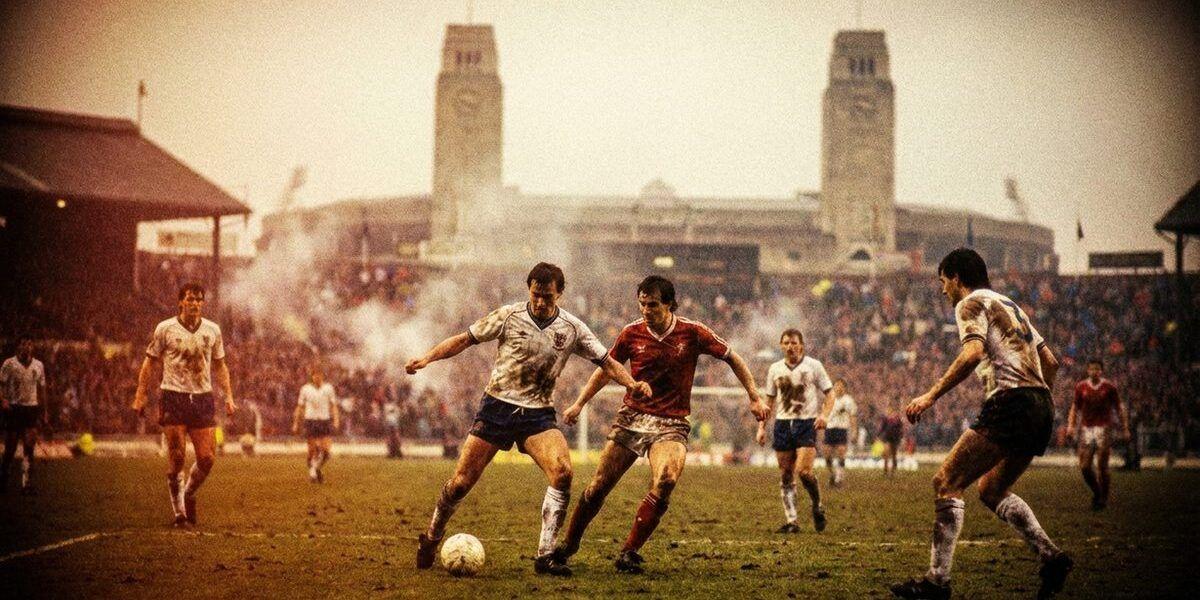
And yet. And yet there was one afternoon that justified everything, one match that sits in the memory like a jewel in a plain setting. The 1987 League Cup final against Liverpool at Wembley.
Liverpool were the dominant force in English football. Arsenal were not. Nobody gave us much of a chance. And for long periods, the match seemed to be heading towards the expected conclusion. Then Nicholas scored. And then he scored again. Both goals were instinctive, sharp, the work of a natural goalscorer operating on pure adrenaline. Arsenal won 2-1, and Charlie Nicholas was the hero.
For ninety minutes on a Wembley afternoon, all the unfulfilled promise, all the frustration, all the “what ifs” simply evaporated. Charlie Nicholas was, for one glorious day, exactly the player we had always hoped he would be.
It was, in many ways, both the pinnacle and the epitaph. George Graham had arrived as manager in 1986 and was already reshaping the club in his own austere image. There was no room for Champagne Charlie in the new Arsenal. Nicholas was sold to Aberdeen in January 1988, having scored 34 goals in 151 appearances. Respectable numbers, but a long way short of what might have been.
The player out of time
This is the second in our series exploring players who existed slightly out of sync with their surroundings, and Nicholas fits the template perfectly. Had he arrived five years later, into Graham’s disciplined, trophy-winning machine, might the structure have channelled his talent more effectively? Or would Graham have simply had no patience for the circus? Had he stayed at Celtic, where he was adored and where the expectations were different, might he have fulfilled that extraordinary early promise?
These are the questions that make football so endlessly fascinating. The roads not taken. The sliding doors. Charlie Nicholas at Arsenal was a story of talent and temperament, of a city that offered too much and a player who couldn’t resist sampling it all. He was not a failure — that League Cup final alone ensures his place in the club’s history — but he was something perhaps more poignant than that. He was a nearly man.
I think about Nicholas sometimes when I watch modern players navigate the pressures of London and celebrity and social media. The temptations have multiplied exponentially, but the fundamental challenge remains the same: can you keep your focus on the thing that brought you here in the first place? Charlie Nicholas, for all his gifts, found that question harder to answer than most.
From this distance, though, what remains is not the disappointment but the flickering brilliance. The quick feet, the sharp mind, those two goals at Wembley. If you’re going to be a nearly man, you might as well be a spectacular one. And Charlie Nicholas was certainly that.