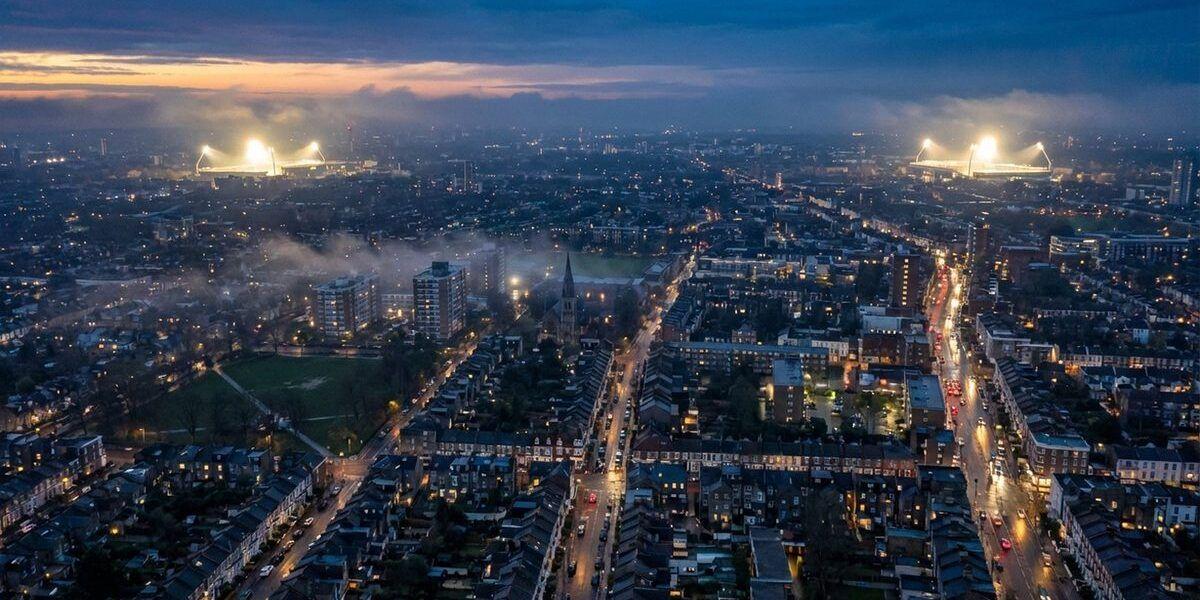
The Origins: How Geography Became Destiny
The North London Derby is not merely a football match. It is a sociological event, a tribal gathering, a twice-yearly referendum on identity and belonging that transcends anything so mundane as sport. Arsenal versus Tottenham Hotspur. Red versus white. Highbury versus White Hart Lane. The Emirates versus the new ground they’re building. The animosity is deep, it is genuine, and it is — for those of us who live it — entirely rational.
The roots of the rivalry stretch back to 1913, when Arsenal — then known as Woolwich Arsenal — relocated from south-east London to Highbury, planting themselves firmly in territory that Tottenham considered their own. The audacity of the move was breathtaking. Spurs protested vigorously. The Football League was largely indifferent. Arsenal stayed. Tottenham seethed. And a rivalry was born that would endure for over a century.
The first competitive meeting between the sides as north London neighbours came in the First Division in January 1921. Arsenal won 2-1. It set a tone.
The Early Decades: Establishing the Hierarchy
The 1930s belonged emphatically to Arsenal. Under Herbert Chapman and then George Allison, Arsenal won five league championships and two FA Cups, establishing themselves as the pre-eminent force in English football. Tottenham, by contrast, spent much of the decade in the Second Division. The power dynamic was clear, and Spurs supporters have never entirely recovered from the indignity.
The pendulum swung in the early 1960s, when Bill Nicholson’s magnificent Spurs side became the first team of the twentieth century to win the Double. It was, Arsenal supporters will concede through gritted teeth, a genuinely great achievement. The side of Blanchflower, Mackay, Greaves, and White played football of rare quality, and for a brief, glorious period, Tottenham were the dominant force in north London.
It didn’t last. These things rarely do at Tottenham.
The Great Matches
The 5-0, 23 December 1978
If one match encapsulates the ecstasy and the agony of the North London Derby, it is this one. Arsenal, inspired by the sublime Liam Brady, demolished Tottenham 5-0 at White Hart Lane four days before Christmas. The performance was so comprehensive, so humiliating for the home side, that it entered Arsenal folklore as perhaps the single most satisfying result in the club’s history. We have written about it at length, and we encourage you to revisit it.
The FA Cup Semi-Final, 1991
Wembley. The national stadium. Gascoigne’s free-kick — a thunderbolt from thirty-five yards — gave Spurs an early lead that seemed to suck the life from Arsenal. Lineker added a second, and for once the white half of north London had bragging rights in the match that mattered most. It remains a painful memory.
Sol Campbell’s Defection, 2001
When Sol Campbell — Tottenham’s captain, their talisman, their home-grown hero — walked out of White Hart Lane at the end of his contract and signed for Arsenal on a free transfer, the footballing world experienced a seismic event. Spurs supporters were apoplectic. Arsenal supporters were delirious. Campbell himself was stoic, insisting it was a footballing decision. Nobody believed him. Nobody cared. He was an Arsenal player, and the betrayal was exquisite.
Campbell’s first return to White Hart Lane in an Arsenal shirt was an occasion of extraordinary hostility. He responded, as he always did, with a performance of imperious calm. The man was unbreakable.
The Battle of Old Trafford… and a Correction
A note of honesty: the image of Martin Keown leaping over Ruud van Nistelrooy, face contorted in primal triumph, is one of the most iconic in Arsenal’s history. But it occurred during a match against Manchester United, not Tottenham. The confusion is understandable — the intensity of the moment felt like a derby — but accuracy demands correction. We shall not allow passion to overrule fact, however tempting.
Adebayor’s Slide, 2009
Emmanuel Adebayor, the former Arsenal striker, scored for Manchester City against his old club and celebrated by sprinting the entire length of the pitch to slide on his knees in front of the Arsenal supporters. Again, this was not strictly a North London Derby moment, but the visceral rage it provoked in Arsenal fans — and the delight it gave Spurs supporters, who would later sign Adebayor — speaks to the interconnected nature of these rivalries. Everything, in north London, is personal.
72 Seconds, 2014
The North London Derby has produced many extraordinary moments, but few as breathlessly swift as the 72-second turnaround that turned a match on its head. The speed, the chaos, the sheer unscripted drama — this is what derbies are for.
The Sociological Divide
What makes the North London Derby different from other rivalries? Geography, certainly — the two grounds are barely four miles apart, and the fan bases overlap in the boroughs of Islington, Haringey, Hackney, and beyond. But the divide is also cultural. Arsenal, rightly or wrongly, have been cast as the establishment club — the marble halls, the Art Deco, the foreign manager with his continental philosophy. Tottenham, equally unfairly, have been portrayed as the plucky underdog, the people’s club, the side that plays with more heart if less silverware.
Both characterisations are reductive, and both contain a kernel of truth. What is undeniable is that the rivalry matters — deeply, viscerally, irrationally. When Arsenal beat Tottenham, the week that follows is luminous. When the result goes the other way, the same seven days stretch like a prison sentence. This is not healthy. It is not rational. It is football.
The Modern Era
The twenty-first century has seen the power balance tip decisively in Arsenal’s favour. St Totteringham’s Day — the date each season when Arsenal’s points total becomes mathematically unassailable by Tottenham — became an annual celebration that Spurs supporters endured with varying degrees of dignity. From 1995 to 2016, Arsenal finished above Tottenham in every single season, a run of consistency that bordered on the supernatural.
Tottenham’s recent resurgence under Mauricio Pochettino has added a new dimension to the rivalry. For the first time in a generation, Spurs are genuine competitors at the top of the table, and the derbies carry a weight that they lacked during the years of Arsenal’s unchallenged superiority. Whether this represents a permanent shift or a temporary blip remains to be seen. Arsenal supporters, naturally, are confident it is the latter.
The North London Derby endures because it speaks to something fundamental about football fandom: the need for an adversary, a counterpoint, a them against which to define us. Arsenal need Tottenham. Tottenham need Arsenal. Neither side would admit it, but both know it to be true. Long may it continue.
The Tactical Evolution
The North London Derby has always been a match in which tactics take a back seat to emotion, but the evolution of the two clubs’ playing styles over the decades has added a fascinating dimension to the rivalry. In the 1930s, the contrast was stark: Arsenal’s revolutionary WM formation under Chapman, with its deep-lying centre-half and withdrawn inside-forwards, against Tottenham’s more conventional approach. The tactical sophistication of Chapman’s side gave Arsenal an advantage that went beyond mere talent — they were playing a different game, and Spurs hadn’t yet learned the rules.
The 1960s saw the dynamic shift. Bill Nicholson’s Double-winning Tottenham side of 1960/61 played with an attacking fluency that set the standard for the decade. Danny Blanchflower’s vision from midfield, Jimmy Greaves’s lethal finishing, and Dave Mackay’s indomitable spirit combined to produce football of rare quality. Arsenal, by contrast, were in a period of relative mediocrity, and the derbies of that era often reflected the disparity. Tottenham’s supporters still speak of this period as their golden age, and they are not wrong to do so — it is simply unfortunate for them that golden ages require some form of continuation to retain their lustre.
George Graham’s Arsenal of the late 1980s and early 1990s brought a very different kind of football to the derby. Graham’s side was built on defensive discipline — the offside trap, the back four moving as a single unit, the willingness to absorb pressure and strike on the counter-attack. It was not pretty, but it was devastatingly effective, and Spurs struggled to break down a defensive system that operated with the mechanical precision of a Swiss watch. The “boring, boring Arsenal” chant, which Spurs supporters adopted with particular relish, was really an expression of frustration at their inability to penetrate Graham’s defensive wall.
The Wenger era transformed the derby once more. Arsenal under the Frenchman played football of such beauty that even Tottenham supporters occasionally had to suppress their admiration. The derby matches of the early 2000s — when Henry, Bergkamp, and Pirès were at their peak — were often one-sided affairs, Arsenal’s technical superiority proving too much for Spurs sides that were competitive without being exceptional. The 3-0 at White Hart Lane in November 2002, in which Pirès and Henry dismantled the Tottenham defence with a display of passing that bordered on the cruel, was a particularly vivid example.
The Supporters: A Study in Contrasts
The relationship between the two sets of supporters is, like all great rivalries, built on a foundation of mutual loathing that masks a deeper, more complex interdependence. Arsenal supporters define themselves partly through their opposition to Tottenham — the songs, the jokes, the reflexive pleasure in Spurs’ failures that is, if we are honest, as intense as the joy derived from Arsenal’s own successes. Tottenham supporters, naturally, feel the same way in reverse.
The songs are instructive. Arsenal supporters sing about Tottenham with a frequency and enthusiasm that would surprise the uninitiated. “Mind the Gap” — a reference to the consistent league table distance between the two clubs during the Wenger years — was a particular favourite. “Spurs are on their way to Wembley” — sung ironically, pointing in the wrong direction — was another. The creativity invested in mocking the opposition is, in its way, a tribute to the rivalry’s importance.
Tottenham supporters give as good as they get. The “boring, boring Arsenal” chant has already been mentioned. “Are you Tottenham in disguise?” — directed at any team that beats Arsenal — is a staple. The mutual abuse is, for the most part, good-natured in intent if occasionally excessive in execution, and it serves the essential function that all football rivalry serves: it gives meaning to the mundane. A Tuesday evening match against a mid-table side in February matters more when the result has implications for the derby bragging rights.
The Future of the Rivalry
As I write this in early 2018, the North London Derby stands at a crossroads. Tottenham, under Mauricio Pochettino, have developed into genuine challengers at the top of the Premier League — a transformation that has forced Arsenal supporters to recalibrate their expectations and, in some cases, their insults. It is harder to mock a team that finishes above you in the league table, as Spurs did in 2016/17 for the first time in over two decades.
Tottenham’s new stadium, currently under construction adjacent to White Hart Lane, represents an investment in the future that mirrors Arsenal’s own Emirates project a decade earlier. The irony is not lost on those of us who watched Arsenal sacrifice short-term competitiveness for long-term financial security. Spurs are now walking the same path, and the lean years that may follow their stadium move could yet restore the familiar order of north London football.
But predictions are foolish things in football, and the North London Derby has a habit of defying rational analysis. What is certain is that the rivalry will endure — passionate, irrational, occasionally ugly, and always, always important. It is, in the end, what football is for: the assertion of identity, the expression of belonging, the primal satisfaction of knowing that you are right and they are wrong. Arsenal and Tottenham. Forever at war. Forever inseparable.
The bragging rights shift with every result, but the underlying truth remains constant: for Arsenal supporters, there is no sweeter victory than one over Tottenham, and no more bitter defeat. It has been this way for over a century. It will be this way for a century more. The North London Derby is not just a fixture on the calendar — it is the fixture, the one that defines seasons, settles arguments, and provides the raw material for a lifetime of memories, grievances, and stories told in pubs across north London and far beyond.