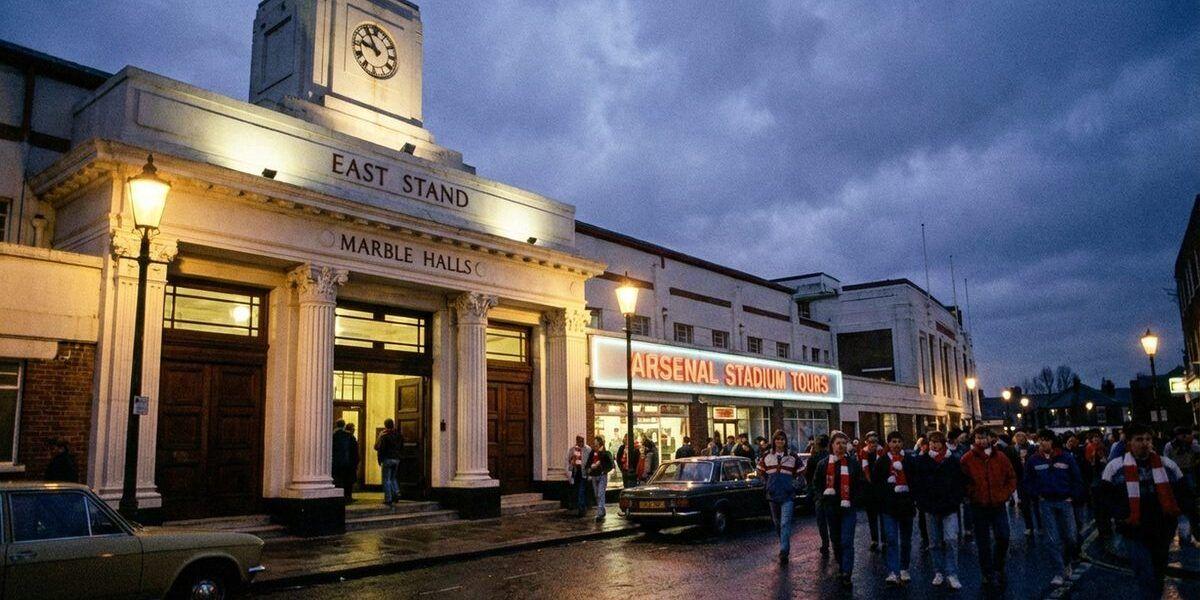
Twenty-seven years. That’s how long it’s been since the first faint stirrings of something extraordinary began at Highbury. In March 1987, Arsenal were a club that had been drifting for the best part of a decade — decent enough, never terrible, but a long way removed from the greatness that the name demanded. George Graham had been in the job for less than a year, and the transformation was already underway.
The state of play
It’s easy to forget just how mediocre Arsenal had become by the mid-1980s. The club hadn’t won the league since 1971. The FA Cup wins in 1979 provided welcome relief, but the First Division title felt like ancient history. Don Howe’s departure in 1986 had left a void that needed filling, and when the club turned to George Graham — a former player, a man who understood what it meant to wear the shirt — not everyone was convinced it was the right appointment.
Graham’s first season was, by any reasonable measure, a work in progress. He was reshaping the squad, imposing his ideas, building the defensive structure that would become the foundation of everything that followed. Results were inconsistent. The football was, at times, hard to watch. But underneath the surface, something was shifting. You could feel it if you were paying attention.
The moment belief took hold
There wasn’t a single match or a single moment, exactly. It was more of a gradual accumulation. The defence began to look organised in a way it hadn’t for years. Tony Adams, still a teenager, was growing into the captaincy with a maturity that belied his age. Viv Anderson brought experience and class. The spine of the team was solidifying.
But if I had to pinpoint the moment when belief began to crystallise, it would be the League Cup run in 1986/87. Arsenal reached the final at Wembley, and although they lost to Liverpool — Charlie Nicholas scored but it wasn’t enough — there was something about the journey that felt significant. This was a team that was learning how to compete at the highest level. The lessons of that final, painful as they were, would prove invaluable.
Football is full of moments that only reveal their significance in retrospect. That League Cup final felt like a defeat at the time. It was only later that we understood it was actually the beginning.
Graham’s method
What George Graham was building, with characteristic bloody-mindedness, was a team in his own image: disciplined, organised, resilient, and absolutely certain of its identity. He didn’t care about being fashionable. He didn’t care about winning admirers in the press box. He cared about winning football matches, and he set about constructing a machine designed to do precisely that.
The back four was the centrepiece. Graham worked with them obsessively — the offside trap, the positioning, the communication, the collective understanding that turned four individuals into a unit that functioned as one. By the time Dixon, Winterburn, Adams and Bould were established as the first-choice quartet, they were arguably the finest defensive unit in English football. But it started here, in the spring of 1987, with early experiments and small improvements that would compound over time.
In midfield, Graham wanted energy and discipline above all else. Michael Thomas would arrive from the youth team and prove to be exactly what was needed — a box-to-box presence with the ability to score crucial goals. David Rocastle was already established, bringing a quality and elegance to the right side of midfield that lent the team an attacking dimension Graham’s critics often overlooked.
The significance in retrospect
Two years after those tentative first steps, Arsenal would win the First Division title in the most dramatic fashion imaginable. Thomas at Anfield. The last kick of the season. A moment that still sends shivers down the spine, no matter how many times you watch it. None of that happens without the groundwork laid in 1986/87. None of it happens without Graham’s willingness to endure a difficult first season while he reshaped the squad in his image.
I think about this whenever I hear fans calling for a manager’s head after a difficult run of results. The modern game demands instant gratification, and I understand that — we all want to see our team win, today, now, immediately. But the best managers need time. Graham needed time. Wenger needed time. Even the greatest coaches in the history of the game needed the space to build something that would endure.
Twenty-seven years on, the 1986/87 season is largely forgotten. It sits in the shadow of what came next — the drama of 1989, the near-perfection of 1991, the European triumph of 1994. But without it, none of those glories would have been possible. It was the season when the foundations were laid, when the culture was established, when a group of players began to understand what George Graham expected of them and, crucially, what they were capable of achieving together.
The beginnings of belief. That’s what March 1987 represents to me. And twenty-seven years later, it still matters. It still resonates. Because every great Arsenal team starts somewhere, and this is where George Graham’s started.
For more on the fruits of Graham’s labour, see our piece on the 1990/91 season and the Luton match, and browse our arsenal history archive.