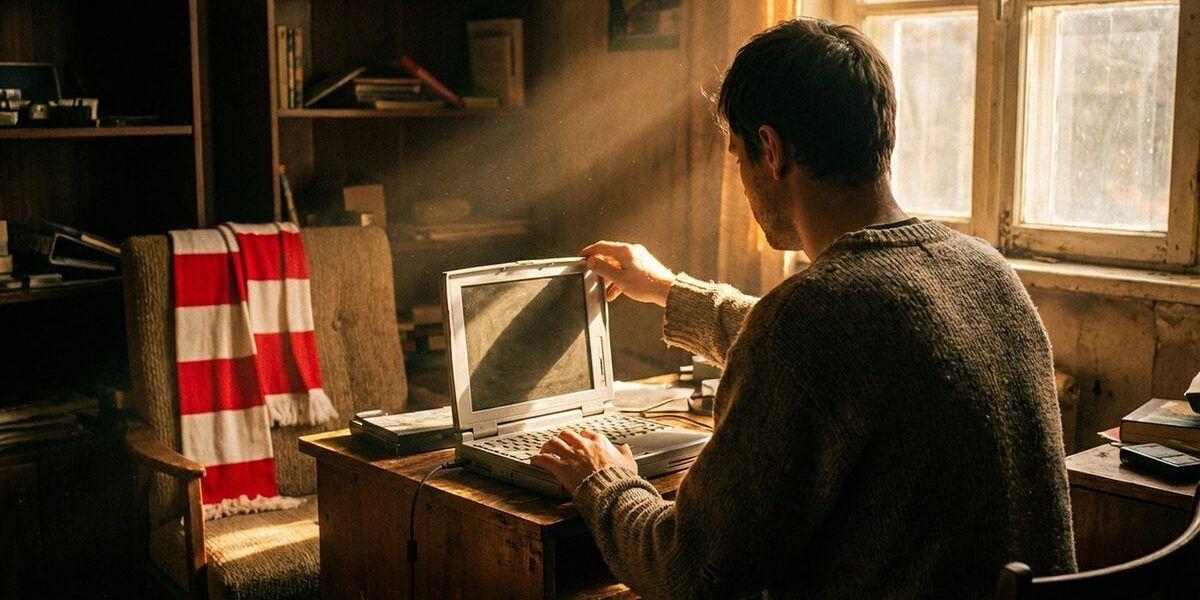
I owe you an apology. Four years is a long time to leave a blog unattended, like a garden you kept meaning to weed but never quite got around to. The brambles have taken over. The shed door hangs on one hinge. But the bones of the thing are still there, and if you squint through the overgrowth, you can see the outlines of something that once mattered.
This blog — this strange, obsessive, occasionally pretentious little corner of the internet — went dark sometime in 2019. Not with a grand farewell or a dramatic final post, but with the quiet whimper of a man who simply ran out of things he wanted to say about Arsenal Football Club. Or rather, a man who had too many things to say, all of them miserable, and who decided that silence was preferable to the sound of his own despair. And as time would tell, the passion endured.
Why I stopped
Let me be honest about this. The final Wenger years broke something in me. Not the man himself — I will defend Arsène Wenger until my dying breath as the most transformative figure in the club’s modern history — but the slow, grinding entropy of those last seasons. The repetition of it. The February collapses that arrived with the predictability of daffodils. The transfer windows that promised revolution and delivered Yaya Sanogo. The creeping sense that we were watching a great man’s legacy curdle in real time.
I wrote about fight and soul back in 2017, trying to articulate what had gone missing from the team. Reading it back now, I can feel the exhaustion between the lines. When Wenger finally left in 2018, it felt less like liberation and more like bereavement — the complicated kind, where relief and grief sit uncomfortably in the same room and neither knows where to look.
Then came Unai Emery. I will not dwell on this. The man arrived with impressive credentials and departed with his dignity in tatters, undone by a language barrier, a squad that needed surgery rather than sticking plasters, and the most excruciating run of results since the bad old days of the early 1990s. Twenty-two games without an away win. I remember watching the draw at home to Southampton — the one where we blew a two-goal lead and Alexandre Lacazette scored that absurd late equaliser — and thinking: I cannot write about this. I have nothing left.
So I stopped. The blog sat there, gathering digital dust, while Arsenal lurched through the tail end of Emery and into the Freddie Ljungberg interregnum and then, in December 2019, into the appointment of a man I was not entirely sure about.
The Arteta question
Mikel Arteta. The name itself sounded like an experiment. A first-time manager, thirty-seven years old, whose primary qualification appeared to be standing near Pep Guardiola for three years and looking serious. I remember the announcement and feeling precisely nothing — not excitement, not dread, just a sort of numb acceptance that this was what Arsenal Football Club had become. A club taking a punt because the alternatives were either unavailable or unaffordable.
I watched from a distance. The FA Cup win in 2020 — genuinely impressive, played with a tactical rigour that Emery’s Arsenal never managed. Then the bewildering slide into the bottom half of the table. Then the Europa League semi-final exit to Villarreal (Emery’s revenge, the scriptwriters working overtime). Then eighth place. Then eighth place again. Two consecutive seasons without European football for the first time since 1995.
And through it all, something was quietly building. I could see it, even through my self-imposed exile. The deadwood was being cleared. The culture was being reset. Young players were being trusted — Saka, Smith Rowe, Martinelli — and they were responding with a hunger that hadn’t been visible at Arsenal for years. The foundations were going in, even if the house didn’t look like much yet.
The season that brought me back
The 2022/23 season. Where do I even begin?
Arsenal started the campaign like a side possessed. Five wins from five. Then six from six. Then the machine kept rolling, and suddenly it was October and we were top of the league and the question had shifted from “Can Arsenal make the top four?” to “Can Arsenal win the title?” The answer, delivered over nine extraordinary months, was: nearly. Beautifully, agonisingly, heartbreakingly nearly.
We led the Premier League for 248 days. We went into the World Cup break five points clear at the top, our best position at Christmas since 2007. We played football of genuine quality — Ødegaard orchestrating everything from the right half-space, Saka terrorising full-backs with that maddening combination of directness and intelligence, Saliba defending like a man who had been doing this for fifteen years rather than at the start of his first proper Arsenal season. Eighty-four points. Our best tally since the Invincibles’ ninety in 2003/04.
That it ended in heartbreak — the wobble after Christmas, the defeats that arrived like buses, Manchester City’s relentless, mechanical accumulation of points — does not diminish what happened. Or rather, it diminishes it only in the way that all near-misses diminish: you feel the absence of the thing you almost had, and it hurts precisely because you got close enough to touch it.
I watched the final day of the season — the 5-0 demolition of Wolves — with something I hadn’t felt about Arsenal in years. Not just hope, though there was plenty of that. Something more fundamental. Recognition. This team felt like us again.
The new generation
Part of what drew me back was the sheer quality of the individuals. Bukayo Saka is the most exciting Arsenal player since a young Cesc Fàbregas used to pick the ball up in midfield and make the Emirates gasp. He has that thing — that ineffable quality — where the ball arrives at his feet and the stadium collectively holds its breath, because anything might happen. He is twenty-one years old. Twenty-one. The thought of what he might become is almost too exciting to contemplate.
Martin Ødegaard arrived with the quiet reputation of a prodigy who had somehow got lost in the Real Madrid system, and has emerged as one of the finest attacking midfielders in the Premier League. His range of passing, his movement, his ability to find pockets of space that shouldn’t exist — he is the creative fulcrum this team was missing for years. That he wears the armband at twenty-four tells you everything about the culture Arteta has built.
And then there is William Saliba. Good Lord, William Saliba. The man defends with the insouciance of someone solving a crossword puzzle. Nothing flusters him. He reads the game two moves ahead, steps out with the ball like a midfielder who happens to be six foot four, and makes the whole thing look absurdly, almost insultingly easy. That Arsenal found him at nineteen, loaned him out for three years while the internet screamed about mismanagement, and then reintroduced him as the best young centre-back in Europe — well, it feels rather like vindication for the whole Arteta project.
I wrote once about the next generation of Arsenal players, wondering whether the club could produce or attract young talent capable of competing at the highest level. The answer, it turns out, was yes. Emphatically, joyously yes.
So here we are
I am back. The blog is back. A Cultured Left Foot returns from its long hibernation, blinking in the sunlight, slightly thinner and considerably greyer, but alive. The compulsion to write about Arsenal — that strange, irrational need to process the emotions of a football club through the medium of overwritten prose — has returned with a force that surprises even me.
There is so much to write about. The transfer window stretches ahead like an open road. The Champions League awaits for the first time in six years. The squad needs strengthening — a central midfielder, perhaps another forward — but the core is magnificent. Young, hungry, talented, and managed by a man who appears to know exactly what he is doing.
I make no promises about frequency. The old regime of three posts a week is probably beyond me now — life has a way of filling the gaps that obsession used to occupy. But I will be here, watching, thinking, writing. Trying to make sense of this beautiful, infuriating, endlessly compelling football club.
I’m back. We’re back. And there is so much to write about.